Tirzepatide for Sleep Apnea: What the SURMOUNT-OSA Trials Showed and What It Means for CPAP
Tirzepatide and sleep apnea explained: SURMOUNT-OSA results, how to read AHI changes, what the FDA approval covers, CPAP questions and key safety points.
Key answer
Tirzepatide reduced breathing disruptions during sleep in adults with obesity and moderate to severe obstructive sleep apnea in the SURMOUNT-OSA trials. After 52 weeks, the apnea-hypopnea index fell by about 20 to 24 more events per hour than with placebo. The U.S. FDA approved the Zepbound brand for this group in December 2024, calling it the first medication approved for obstructive sleep apnea. It is a prescription option alongside diet and activity, not a replacement for a sleep specialist’s assessment.
Obstructive sleep apnea is one of those conditions many people live with for years without knowing. Loud snoring, gasping at night, morning headaches and daytime exhaustion are often brushed off as just bad sleep. Yet untreated sleep apnea is linked to serious problems, and for a long time treatment has relied mainly on breathing devices, oral appliances, weight loss and, in some cases, surgery.
In late 2024 that changed. A medicine first developed for diabetes and weight management became the first drug approved specifically for obstructive sleep apnea in a defined group of adults. This guide explains what tirzepatide is, what the sleep apnea trials actually measured, how to read the results without inflating them, what the approval does and does not cover, the safety picture, and the practical questions to raise with your doctor and pharmacist.
What Is Obstructive Sleep Apnea?
In obstructive sleep apnea, often shortened to OSA, the upper airway repeatedly narrows or closes during sleep. Breathing stops briefly or becomes very shallow, oxygen levels can dip, and the brain briefly wakes the body to restart breathing. These interruptions can happen many times an hour, often without the person remembering them.
Excess body weight is one of the strongest risk factors, because fatty tissue around the neck and upper airway can make collapse more likely. Other contributors include the shape of the jaw and airway, enlarged tonsils, alcohol or sedatives at bedtime, smoking and older age. OSA is different from central sleep apnea, a less common condition where the brain does not send the usual signals to breathe.
This animated overview from Osmosis covers the causes, symptoms, diagnosis and standard treatment of sleep apnea:
Signs You Might Have Sleep Apnea
Many people with OSA are first alerted by a bed partner rather than by their own symptoms. Common warning signs include loud, regular snoring; pauses in breathing that someone else notices; choking or gasping during sleep; waking with a dry mouth or headache; waking often to urinate at night; and feeling unrefreshed despite a full night in bed. During the day, people may feel sleepy, irritable or foggy, and some find themselves nodding off while reading, watching television or even driving.
None of these signs proves sleep apnea on its own, and some people with significant OSA have few obvious symptoms. If several apply to you, especially alongside risk factors such as excess weight or high blood pressure, it is worth raising with a doctor.
Why Untreated Sleep Apnea Matters
Repeated drops in oxygen and constant micro-awakenings put strain on the body. Untreated OSA has been linked with high blood pressure, heart rhythm problems, heart disease and stroke, as well as worse blood sugar control. Daytime sleepiness raises the risk of accidents at work and on the road, and poor sleep affects mood, concentration and quality of life. These links are a major reason why diagnosing and treating OSA is taken seriously, and why a new treatment option attracted so much attention.
How Sleep Apnea Is Diagnosed
Diagnosis usually involves a sleep study. A full study in a sleep laboratory, called polysomnography, records breathing, oxygen levels, heart rhythm, brain activity and movement overnight. For many adults with suspected OSA, a simpler home sleep test that tracks breathing and oxygen can be used instead. The results produce the AHI and help the clinician decide how severe the condition is and which treatments make sense. Repeat testing is often used later to check how well treatment is working.
How Sleep Apnea Is Measured: AHI
To understand the tirzepatide results, you need one number: the apnea-hypopnea index, or AHI. It counts the number of apneas (breathing stops) and hypopneas (very shallow breathing) per hour of sleep, usually measured in a sleep study.
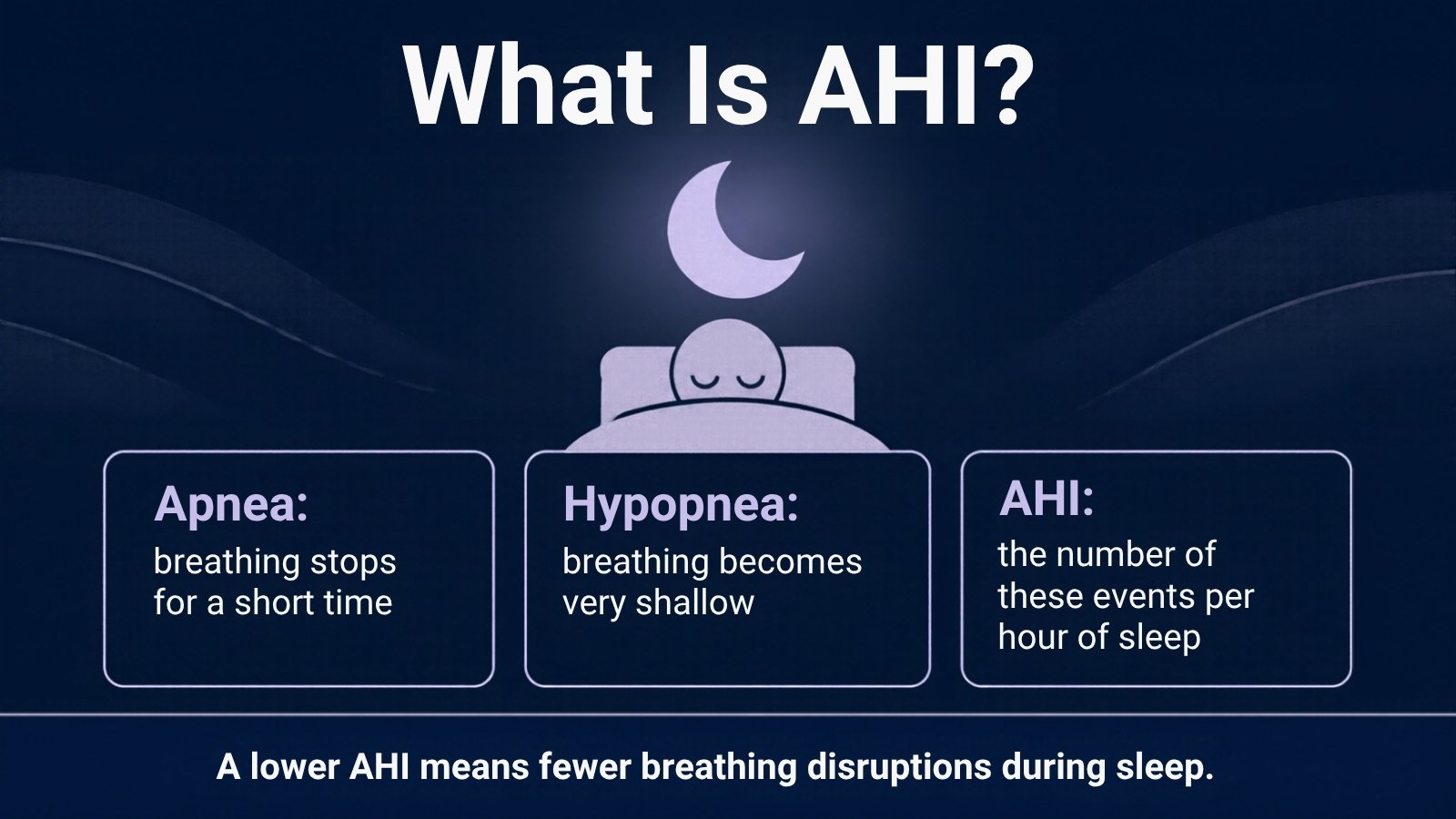
In general terms, a higher AHI means more frequent breathing disruptions and more severe sleep apnea. The SURMOUNT-OSA trials enrolled adults with moderate to severe OSA, so participants started with frequent nightly disruptions. AHI is a measure of breathing during sleep. It is not the same as weight change, and it is not the same as how rested someone feels, although these can be related.
What Is Tirzepatide?
Tirzepatide is a once-weekly injectable peptide medicine that activates receptors for two gut hormones, GIP and GLP-1. These pathways influence blood sugar control and appetite, and tirzepatide reduces appetite and food intake, leading to weight loss in many people. In the United States it is sold as Mounjaro for type 2 diabetes and as Zepbound for chronic weight management and, now, obstructive sleep apnea in specified adults.
The FDA’s announcement on approving the first medication for obstructive sleep apnea explains that the improvement in OSA is considered likely related to body weight reduction. That is an important framing: tirzepatide is thought to help sleep apnea mainly by addressing one of its biggest drivers, rather than by acting directly on the airway.
Tirzepatide and Sleep Apnea: The SURMOUNT-OSA Trials
The evidence comes from two randomized, double-blind phase 3 trials, together called SURMOUNT-OSA, published in the New England Journal of Medicine as Tirzepatide for the Treatment of Obstructive Sleep Apnea and Obesity. Both ran for 52 weeks and compared tirzepatide with placebo. They were funded by the manufacturer, Eli Lilly.
The two trials covered different real-life situations. One enrolled people who were not using positive airway pressure (PAP) therapy, such as a CPAP machine, at the start. The FDA describes this group as unable or unwilling to use PAP. The other enrolled people who were already using PAP. Across both, FDA reports 469 adults, all with obesity and moderate to severe OSA, and none with type 2 diabetes.
The results
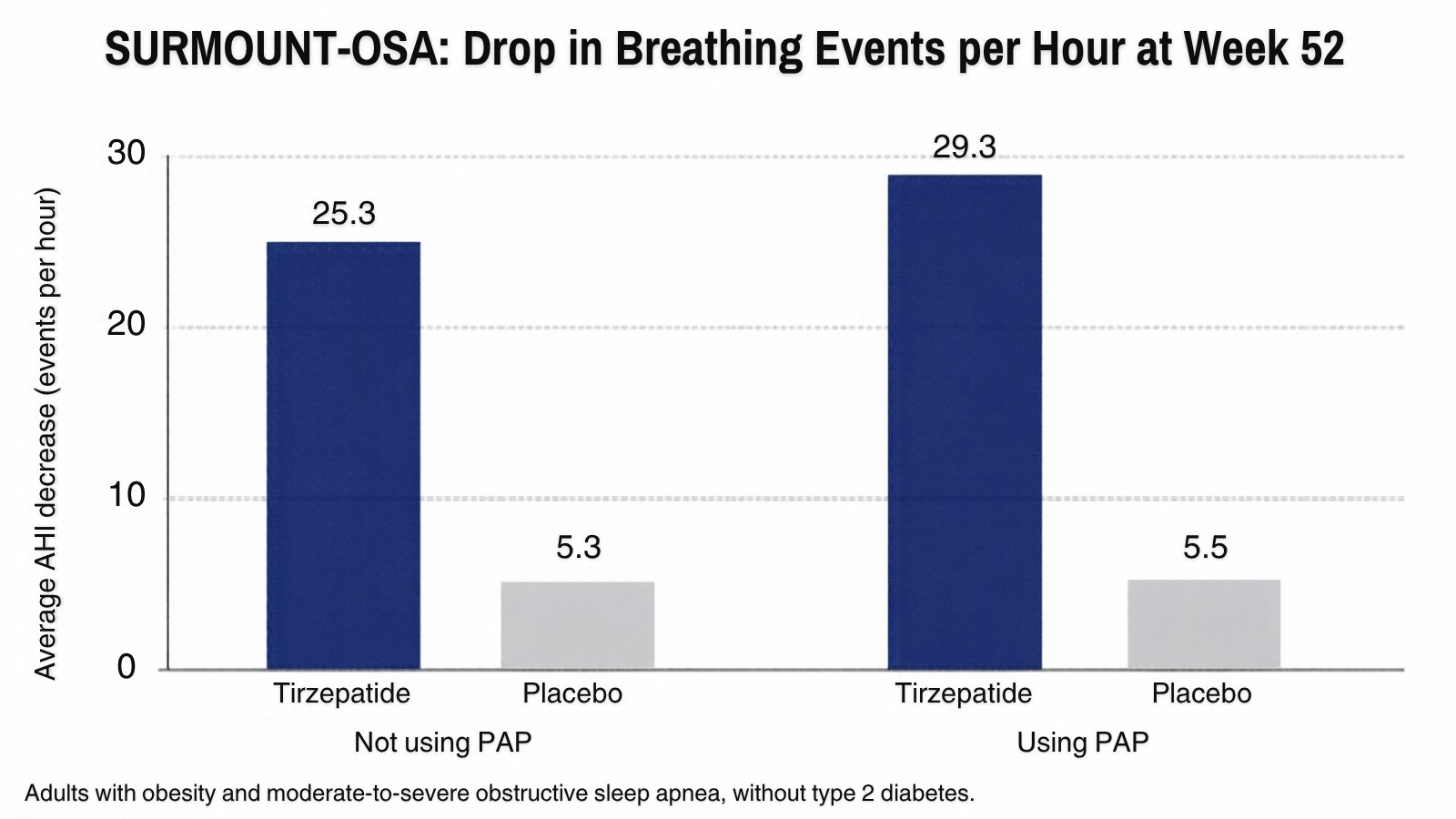
| Trial group | Tirzepatide: AHI decrease | Placebo: AHI decrease | Difference |
|---|---|---|---|
| Not using PAP at baseline | 25.3 events/hour | 5.3 events/hour | 20.0 fewer |
| Using PAP at baseline | 29.3 events/hour | 5.5 events/hour | 23.8 fewer |
Both comparisons met the trials’ prespecified statistical thresholds. FDA also reported that more people on tirzepatide reached remission or mild OSA with resolution of symptoms than those on placebo.
How to read these numbers correctly
A few details keep these results from being misunderstood, a point The Peptides Blog makes carefully in its review of the SURMOUNT-OSA human trial results.
These are changes, not end points. A decrease of 25.3 events per hour does not mean participants finished with an AHI of 25.3. It means their AHI fell by that much on average from where they started.
The unit is per hour, not per night. Twenty fewer events per hour adds up over a full night of sleep, which is why the change is clinically meaningful.
Placebo groups improved too. The difference column shows the extra improvement linked to tirzepatide under trial conditions, which is the fairest estimate of the medicine’s effect.
“Remission or mild OSA” is a combined category. It is encouraging, but it does not mean everyone in that group was cured.
How Much Is Weight Loss Doing?
FDA considers the improvement likely related to weight reduction, and the data support that picture. A later exploratory analysis published in Sleep Medicine, looking at the time course of sleep-disordered breathing and its association with body weight in SURMOUNT-OSA, reported greater improvements among participants who lost more weight.
Exploratory analyses like this help researchers understand how a treatment works, but they cannot prove that weight loss is the only pathway, or rule out other effects. The practical takeaway is simple: the benefit appears closely tied to weight loss, so it likely depends on maintaining that weight loss over time.
What About CPAP and Other PAP Therapy?
This is the question most people with sleep apnea ask first: can I stop using my machine? The honest answer is that the trials were not designed to tell you that.
According to the prescribing information, people in the PAP trial were asked to stop PAP for seven days before the main sleep measurement, so the medicine’s effect could be assessed on its own. The label states that the trials did not evaluate when, or whether, it is appropriate to stop PAP in people who had been using it as prescribed. The trials also did not compare tirzepatide directly against PAP. Each compared tirzepatide against placebo.
So these results support tirzepatide as an additional treatment option, not as a signal to put the machine away. Any change to PAP should follow a fresh assessment by your sleep clinician, often including a repeat sleep study. Feeling better or losing weight is encouraging but cannot replace that assessment.
What the Approval Covers
The FDA approved Zepbound on December 20, 2024, for moderate to severe obstructive sleep apnea in adults with obesity, in combination with a reduced-calorie diet and increased physical activity. That wording sets clear boundaries.
It covers: adults with obesity and moderate to severe OSA.
It does not establish: a benefit for central sleep apnea, a benefit for people without obesity, a cure that lasts after treatment stops, or guidance on stopping PAP.
Approval status and brand availability differ between countries, so readers outside the United States should check how tirzepatide is approved and regulated where they live. Our guide on prescription safety for patients and families in India covers why it matters to use only properly prescribed and dispensed medicines.
If you want to understand why one approval for a specific product and population does not extend to everything sold under the same ingredient name, The Peptides Blog’s guide to what people mean by peptide therapy and how status is checked is a clear explainer.
Safety: Benefits Come With Real Risks
In SURMOUNT-OSA, the most common side effects were gastrointestinal, such as nausea, diarrhea, vomiting and constipation, and most were mild or moderate. The prescribing information also describes severe gastrointestinal reactions and warns about pancreatitis and gallbladder disease.
Like other medicines in this class, tirzepatide carries a boxed warning about thyroid C-cell tumors seen in rats; whether this happens in humans is not known. It should not be used by people with a personal or family history of medullary thyroid carcinoma or multiple endocrine neoplasia syndrome type 2, or by anyone who has had a serious allergic reaction to tirzepatide or its ingredients.
Other practical points: tirzepatide slows stomach emptying, which can affect how some oral medicines are absorbed, and stomach side effects can lead to dehydration. People already taking blood pressure medicine may also see their readings fall as they lose weight, a topic covered in The Peptides Blog’s look at the blood pressure findings from SURMOUNT-1. A full medicine review with your pharmacist at the start is worthwhile.
Sleep Apnea Treatment Options Compared
| Option | How it helps | Things to know |
|---|---|---|
| PAP therapy (such as CPAP) | Air pressure keeps the airway open during sleep | Works while worn; comfort and consistency matter |
| Oral appliances | Reposition the jaw to keep the airway open | Fitted by a dentist; often for mild to moderate OSA |
| Weight loss through lifestyle | Reduces tissue that can narrow the airway | Benefits depend on keeping weight off |
| Tirzepatide (Zepbound) | Weight reduction linked to fewer breathing events | Prescription; adults with obesity and moderate to severe OSA |
| Surgery or implanted devices | Change airway structure or stimulate airway muscles | For selected patients after specialist evaluation |
Who Was Not Studied
It helps to be clear about the people SURMOUNT-OSA did not cover. Participants did not have type 2 diabetes, so the trials do not directly show results in people with diabetes, although tirzepatide is separately approved for blood sugar control under a different brand. People without obesity were not included. Children and adolescents were not studied. People with central sleep apnea, or with mixed forms, were not the focus. If you fall into any of these groups, the trial averages are a weaker guide, and individual medical advice matters even more.
What Happens if Treatment Stops?
Because the sleep apnea benefit appears closely tied to weight loss, it is reasonable to expect that regaining weight could bring breathing problems back. With anti-obesity medicines in general, many people regain weight after stopping treatment. That means decisions about starting, continuing or stopping tirzepatide should be planned with your prescriber and sleep clinician, ideally with follow-up testing, rather than made on your own once you start to feel better.
Getting Tirzepatide Safely
Demand for GLP-1 based medicines has created a market for unapproved and counterfeit products, often sold online without a prescription or labelled for research use only. These products have no verified quality standards, may contain the wrong amount of active ingredient or none at all, and are not covered by any of the trial evidence discussed here. Use a licensed prescriber and a licensed pharmacy, check the packaging, and ask your pharmacist if anything looks unusual.
Everyday Steps That Support Better Sleep Breathing
Whatever treatment plan you follow, some habits help. Avoiding alcohol and sedatives close to bedtime reduces airway relaxation. Sleeping on your side rather than your back helps some people. Stopping smoking reduces airway inflammation. Keeping a regular sleep schedule and treating nasal congestion can make PAP or other treatments more comfortable. For more on building healthy routines that support long-term health, see our practical tips for managing everyday health needs.
Questions to Ask Your Sleep Clinician and Pharmacist
Bring your sleep study report and a list of your current treatments. Useful questions include: How severe is my sleep apnea based on my AHI? Is it obstructive, central or mixed? Would tirzepatide be appropriate for me, given my weight, other conditions and medicines? How would we measure whether it is working, and when would I have a follow-up sleep study? Should I keep using my PAP machine in the meantime? What side effects should I watch for, and how should I handle nausea or dehydration?
Your pharmacist can also check for interactions with other medicines, explain how to use and store the injection pen, and advise on what to do if you miss a dose.
Common Misunderstandings
“Tirzepatide cures sleep apnea.” The trials showed substantial reductions in breathing events, and some people reached remission or mild OSA, but a cure that lasts after stopping treatment has not been shown.
“I can stop my CPAP once I start.” The trials did not evaluate when to stop PAP. Only your sleep clinician should make that call, usually after re-testing.
“It works for any kind of sleep apnea.” The approval is for obstructive sleep apnea in adults with obesity. Central sleep apnea was not studied.
“Feeling more rested proves it is working.” Feeling better is welcome, but AHI on a sleep study is how improvement is measured.
“Any tirzepatide product is the same.” The evidence and approval apply to the regulated, approved product. Unapproved products sold online are not equivalent and carry unknown risks.
The Bottom Line
The SURMOUNT-OSA trials gave people with obesity and moderate to severe obstructive sleep apnea a genuinely new option: a medicine that, on average, cut breathing disruptions by around 20 to 24 more events per hour than placebo over a year. The benefit appears closely linked to weight loss, it comes with real side effects and warnings, and it does not replace a sleep specialist’s assessment or automatically replace PAP. Understanding those limits is what turns a headline into a useful conversation with your care team.
For clear explanations of the trials behind peptide medicines, explore peptide benefits and the research behind them at The Peptides Blog’s evidence-first medicine guides, an independent educational publication that does not sell medicines or provide consultations.
Frequently Asked Questions
Is tirzepatide approved for sleep apnea?
Yes, in the United States. FDA approved Zepbound on December 20, 2024, for moderate to severe obstructive sleep apnea in adults with obesity, used with a reduced-calorie diet and increased physical activity. Approval status varies in other countries.
How much did tirzepatide reduce sleep apnea events?
At 52 weeks, AHI fell by 25.3 events per hour with tirzepatide versus 5.3 with placebo in people not using PAP, and by 29.3 versus 5.5 in people using PAP. The differences were 20.0 and 23.8 events per hour.
Can I stop using CPAP if I take tirzepatide?
The trials did not evaluate when it is appropriate to stop PAP. Do not stop or change PAP therapy without guidance from your sleep clinician, who may repeat a sleep study first.
Does tirzepatide work for central sleep apnea?
The trials studied obstructive sleep apnea only. There is no evidence from these trials for central sleep apnea.
Why does tirzepatide help sleep apnea?
FDA considers the improvement likely related to weight reduction. An exploratory analysis found greater improvements in people who lost more weight.
What are the main side effects?
Gastrointestinal effects such as nausea, diarrhea, vomiting and constipation are most common. The label also warns about pancreatitis, gallbladder disease and thyroid C-cell tumors seen in rats.
Medical disclaimer
This article is general educational information about published research and regulatory decisions. It is not medical advice, does not recommend any medicine, and must not be used to diagnose or treat sleep apnea. Never stop or change PAP therapy or any prescribed treatment without your clinician’s guidance.
Tirzepatide is a prescription medicine with significant risks and should only be used under medical supervision and dispensed by a licensed pharmacy. Approvals, brand names and regulations differ between countries and may change. Seek urgent care if you experience severe abdominal pain, signs of an allergic reaction or other serious symptoms.

Ellen Stevens
More articles by this author